


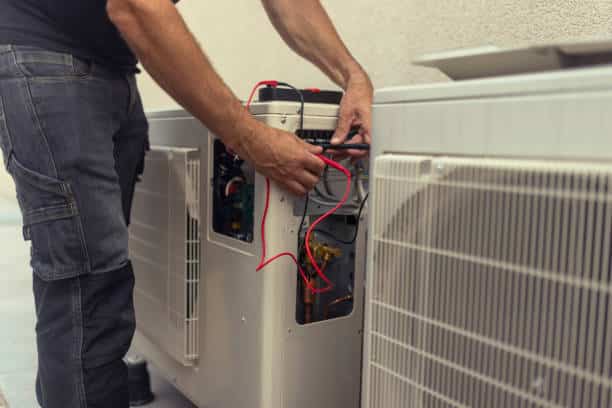
If you live where Cecil County, Maryland, New Castle County, Delaware and Chester County, Pennsylvania meet in the Tri-State area, you know the routine. Every autumn, you start keeping a nervous eye on heating oil prices. Then comes winter, and the delivery truck backs down your driveway to fill up a 275-gallon steel tank sitting in your basement, garage, or buried under your yard.
By March, you’ve spent thousands of dollars just to stay warm and you still don't have a way to cool your home come July without dragging noisy, heavy window AC units out of the attic.
If your oil furnace or boiler is over 15 years old, you’ve probably heard about switching to a Cold-Climate Heat Pump (ccHP). But search online and you'll run into a wall of generic advice that ignores the realities of living right here on the state line.
This guide, from Moon Air, breaks down everything you need to know about ditching oil for an all-electric heat pump, tailored specifically to our local climate, unique homes, and cross-border rebate programs.
The Tri-State Reality: Why Oil Needs to Go
Heating oil used to be the default standard for homes across Elkton, West Chester, Rising Sun, and Wilmington. Today, it’s one of the most expensive and inefficient ways to heat a home.
Heating Oil vs. Cold-Climate Heat Pump
| Feature | Old Oil System | Modern Heat Pump |
| Fuel & Pricing | Volatile seasonal prices | Consistent electric rates |
| Efficiency Rating | 70% to 80% AFUE efficiency | 200% to 400% efficiency |
| Capabilities | Heating ONLY (No AC) | Heating AND Cooling |
| Environmental & Safety | Risk of basement leaks & oil odor | Clean, zero fuel odor, zero spill risk |
When you burn heating oil, an average furnace only converts 70% to 80% of that fuel into actual heat for your home. The rest goes straight up the chimney.
By contrast, modern cold-climate heat pumps don’t create heat by burning fuel; they transfer heat from the outside air into your house using variable-speed inverter technology.
Because moving heat requires far less energy than creating it, heat pumps operate at 200% to 400% efficiency, even when it's freezing outside.
Myth Buster: Heat Pumps Don't Work in North East Winters
That was true in 1990, but not today. Modern cold-climate heat pumps deliver 100% heating capacity down to 0°F and continue producing warm air down to -13°F. You will not freeze during a Cecil County snowstorm or a Chester County ice drop.
Matching Heat Pumps to Our Local Homes
A ranch house in Perryville, MD has completely different heating needs than an 1850s stone farmhouse in Chadds Ford, PA.
How your current system is built determines your ideal conversion setup:
Scenario A: You Have an Oil Furnace with Air Ducts
-
The Upgrade: A Central Ducted Cold-Climate Heat Pump.
-
How It Works: We swap out the old oil burner in your basement and connect a new heat pump unit directly to your existing duct network. You get central heat and central air conditioning from the same system.
Scenario B: You Have an Oil Boiler with Radiators (No Ducts)
-
The Upgrade: A Multi-Zone Ductless Mini-Split System.
-
How It Works: Since adding bulky ductwork to plaster-wall or historic homes can ruin their charm, small, whisper-quiet indoor units (mounted high on walls or tucked into ceiling cassettes) are installed in main room zones. Each zone gets its own independent thermostat control.
Scenario C: You Live in an Uninsulated Historic Home
-
The Upgrade: A Dual-Fuel (Hybrid) System.
-
How It Works: A heat pump handles 85% of your heating during mild to moderate winter days. On the handful of ultra-cold nights when an uninsulated home loses heat rapidly, a backup system kicks in automatically to assist.
What Nobody Tells You: What Happens to the Old Oil Tank?
Most online guides forget to mention the tank in your basement or back yard. Disconnecting an oil system isn't as simple as turning off a switch. Because local municipal codes differ across state lines, tank removal requires a strict, step-by-step procedure:
1. Fuel Pump-Out & Reclamation: Safety First.
Before disconnecting pipes, any remaining usable oil and bottom sludge must be safely pumped out to eliminate spill risks.
2. Permits & Inspections:Code Compliance.
Local rules matter: Cecil County (MD) requires environmental reporting through the MDE for tank decommissioning, while townships across Chester County (PA) require local Fire Marshal approval prior to tank cutting or backfilling.
3. Physical Removal or Slurry Fill: Site Cleanup.
Above-ground basement tanks are cut open, cleaned, and recycled as scrap. Underground tanks are either excavated entirely or cleaned and filled with certified foam/slurry to protect your home's foundation.
4. Fill Pipe Capping: Crucial Final Step.
Fill and vent pipes on your home's exterior must be physically removed or capped immediately so a delivery driver never accidentally pumps oil into a decommissioned basement!
The Tri-State Incentive Stack - Rebates & Tax Credits
The biggest advantage of converting right now is the sheer volume of utility incentives designed to help homeowners ditch fossil fuels. However, how much you save depends entirely on which side of the state line you call home.
If You Live in Cecil County, MD:
Maryland runs one of the most generous electrification initiatives in the country through EmPOWER Maryland (via Delmarva Power):
-
$100 Home Energy Audit: A BPI-certified auditor performs a diagnostic blower-door test to pinpoint heat loss in your home.
-
Up to $15,000 in Direct Equipment Rebates: Covers up to 75% of conversion costs when switching from oil to an energy-efficient cold-climate heat pump.
-
Subsidized Weatherization: EmPOWER pays up to 75% of the cost to insulate your attic and seal duct leaks before the new system goes in!
If You Live in Chester County, PA:
Pennsylvania homeowners stack utility incentives through PECO and regional electrical associations:
-
PECO Act 129 Rebates: Direct rebates for high-efficiency ENERGY STAR heat pumps.
-
EAP Bonus Stacking: By working with a registered contractor, you can stack Electrical Association of Philadelphia (EAP) bonuses on top of PECO rebates for up to $1,950+ in combined savings on high-efficiency (18+ SEER2) heat pumps.
-
Federal 25C Tax Credit: Claim 30% of your remaining project cost (up to $2,000) on your annual federal tax return.
What Does This Look Like in Real Life?
Let’s look at two typical homes right in our area to see how the numbers play out after incentives.
| Home Scenario | Original Setup | Upgrade Installed | Gross Cost | Combined Rebates & Credits | Net Investment | Annual Fuel Savings |
|---|---|---|---|---|---|---|
|
Elkton, MD
2,200 sq. ft. Split-Level
|
20-yr oil furnace + window AC units | Central Cold-Climate Heat Pump + Attic Insulation | $18,500 | -$12,500 (EmPOWER MD + Federal) |
$6,000 | ~$2,400 / yr |
|
West Chester, PA
2,600 sq. ft. Colonial
|
Oil boiler + cast iron radiators | 4-Zone Ductless Hyper-Heat System | $16,000 | -$3,950 (PECO + EAP + Federal) |
$12,050 | ~$1,800 / yr |
Your Conversion Checklist: Questions to Ask Before You Hire
Before you sign a contract with an HVAC installer, make sure they can answer these four crucial questions:
-
Will you perform a Manual J Load Calculation?
Never let a contractor just replace your old furnace with the same size heat pump. Oil furnaces were almost always oversized. A Manual J calculation measures your home's exact insulation and window values to size your new system perfectly.
-
Are you licensed in both Maryland and Pennsylvania?
If you live near the border, you need a contractor who understands both MD Master License requirements and PA Home Improvement Contractor registrations.
-
Do you handle the rebate paperwork directly?
Navigating utility portals like EmPOWER Maryland or PECO Act 129 can be confusing. Look for contractors who apply rebates directly to your invoice as an instant discount.
-
What is the cold-weather performance rating of this unit?
Ensure the quoted model is explicitly rated as a Cold-Climate Heat Pump with an AHRI certificate proving it maintains capacity when temperatures dip below freezing.
Step 1: Calculate Your Current Annual Heating Cost (Oil)
Find out how much usable heat your home gets out of your oil furnace/boiler each winter.
1. Check Your Deliveries: Look at your winter receipts. Let's say a typical 2,200 sq. ft. home uses 700 gallons of heating oil per year.
2. Account for Furnace Efficiency: One gallon of heating oil contains 138,500 BTUs of potential energy. However, an aging oil furnace operating at 75% AFUE efficiency loses 25% of that heat up the chimney.
- Usable Heat per Gallon = 138,500 x 0.75 = 103,875 BTUs
3. Calculate Total Heat Needed:
- 700 gallons x 103,875 BTUs = 72.71 Million BTUs (MMBTUs) of heat per winter
4. Current Cost: At an average heating oil price of $4.00/gallon:
- Annual Oil Cost = 700 gallons x $4.00 = $2,800/year
Step 2: Calculate Your Future Heating Cost (Heat Pump)
Heat pumps don't create heat by burning fuel; they move heat from the outside air into your home using variable-speed inverter technology.
1. Determine Heat Pump Efficiency (COP): Modern cold-climate heat pumps have an average seasonal Coefficient of Performance (COP) of 3.0 (meaning for every 1 unit of electricity put in, it transfers 3 units of heat energy into your home—or 300% efficiency).
2. Convert to Kilowatt-Hours (kWh):
- 1 kWh of electricity = 3,412 BTUs.
- At a 3.0 COP, 1 kWh delivers 10,236 BTUs of heat.
3. Calculate Required Electricity: To deliver the same 72.71 Million BTUs your home requires:
- Electricity Needed = 72,712,500 BTUs / 10,236 BTUs/kWh = 7,104 kWh/year
4. Future Cost: Combined utility rates (supply + delivery) average roughly $0.18/kWh across Delmarva Power (MD) and PECO (PA).
- Annual Heat Pump Cost = 7,104 kWh x $0.18 = $1,278.72/year
Step 3: Calculate Net Annual Operating Savings
Now compare your current oil heating costs directly against your projected heat pump operating costs to find your total annual savings:
- Current Oil Heating Cost: $2,800.00 / year
- Future Heat Pump Cost: - $1,278.72 / year
------------------------------------------------Net Annual Heating Savings: $1,521.28 / year
The Hidden Financial Benefits
Your actual financial return is usually higher than pure heating fuel savings due to three additional factors:
-
Summer AC Efficiency Gains: Replacing old 10–12 SEER central AC or window units with a 18–20 SEER2 heat pump typically reduces summer cooling bills by another $200–$400/year.
-
Eliminating the Oil Tank Service Contract: Most oil suppliers require annual burner tune-ups and tank insurance, costing $200–$350/year.
-
No Minimum Delivery Minimums: You eliminate the cash-flow crunch of sudden $800–$1,000 oil delivery invoices during mid-winter cold snaps.
Key Rule of Thumb:
In the Mid-Atlantic area, as long as heating oil remains above $3.20/gallon and electricity stays near $0.18/kWh, a cold-climate heat pump will consistently beat an oil furnace on operating costs every single winter.
Related Oil Conversion Information
Oil-to-Gas Conversions