


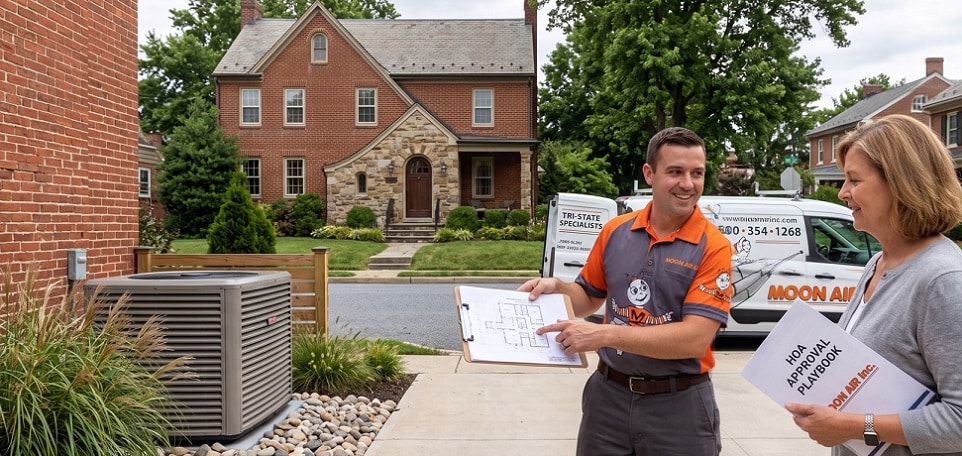
The Tri-State (MD, PA, DE) HOA & Historic District Playbook
If you live in a historic town like West Chester, an established neighborhood in Newark, or a master-planned community in Cecil County, you know the struggle. You want the lower monthly bills and year-round comfort of a modern heat pump or ductless mini-split. But every time you look at your exterior walls, you remember the HOA board or Historic Commission watching over the neighborhood.
At Moon Air, we’ve been installing heating and cooling systems across Maryland, Delaware, and Pennsylvania since 1985. Over four decades, we’ve learned a big secret: Architectural Review Boards (ARBs) rarely reject heat pumps because of the tech. They reject them because of visible lines, street view placement, and sound.
Here is the exact playbook to get your approval on the very first try, including a few field secrets most HVAC companies won’t tell you.
1. Play the Decibel Card Early
Most board members assume heat pumps sound like noisy 1990s air conditioners. Older units run at 70 to 75 decibels (dBA), which sounds like a lawnmower running right outside your neighbor’s window.
When you submit your application, make sure your contractor gives you the manufacturer’s sound data sheet.
Inverter-driven variable-speed heat pumps operate between 48 and 56 dBA. Meaning they run quieter than a normal household refrigerator or a soft conversation. Highlighting this number right on page one puts board concerns about noise to rest immediately.
2. Master the Line-Hide Route – The #1 Rejection Trap
Ductless mini-splits use slim copper lines that run along the outside of your house to connect the indoor wall unit to the outdoor condenser. If those lines look like plastic pipes slapped across your siding, the historic board will turn your application down in a heartbeat.
Here is how we hide them:
-
Paint-Matching: Plastic line covers (called line-hides) can be primed and painted to match your precise paint code, whether it’s brick, vinyl siding, or trim.
-
Architectural Alignment: We route line-hides directly against vertical corner boards, hidden behind existing gutter downspouts, or tucked under soffits so they visually disappear into your home’s trim lines.
3. Don’t Suffocate Your Equipment
Most HOAs require outdoor units to be shielded from street view with a fence or shrubbery. But if you pack bushes too close to a heat pump, you will strangle its airflow, spike your power bill, and void your factory warranty.
4. The Hidden Secret: Sleeve-Routing Through Historic Brick & Siding
Here is something you won’t find on standard HVAC blogs: Historic Commissions are usually far more concerned about permanent structural damage than the unit itself.
If you live in a historic home with solid brick, stone, or original timber siding, drilling a large hole straight through the front facade can cause permanent masonry damage or moisture leaks.
To solve this, our HVAC technicians use a technique called sleeve-routing.
Instead of punching holes through prominent stone or historic brick facade, we route lines down through floor joists, out through existing foundation vents, or through non-historic additions at the rear of the house. This preserves your home’s original materials while keeping the installation 100% reversible, which historic boards love to see.
What Comes Next?
You don’t have to navigate board meetings, site diagrams, or decibel charts alone. When you partner with Moon Air for a heat pump or ductless mini-split quote, we build your board packet for you.
We provide top-down site location maps, exact decibel ratings, equipment spec sheets, and photo mockups of proposed line-hide routes so you can submit your paperwork with confidence.
Ready to start your project?
Give the Moon Air team a call at 410-819-2507 or schedule your home consultation online.
We’ll map out your system, handle the paperwork details, and make getting HOA approval simple.